Why test your bollards?
Bollards are an essential element of safety for any port or quayside structure. Their function is to reliably secure a vessel at berth to its mooring lines during any ship-on-shore operations.
As ships become larger and freeboard increases, the need for bollards becomes increasingly demanding and imperative.
How does it work?
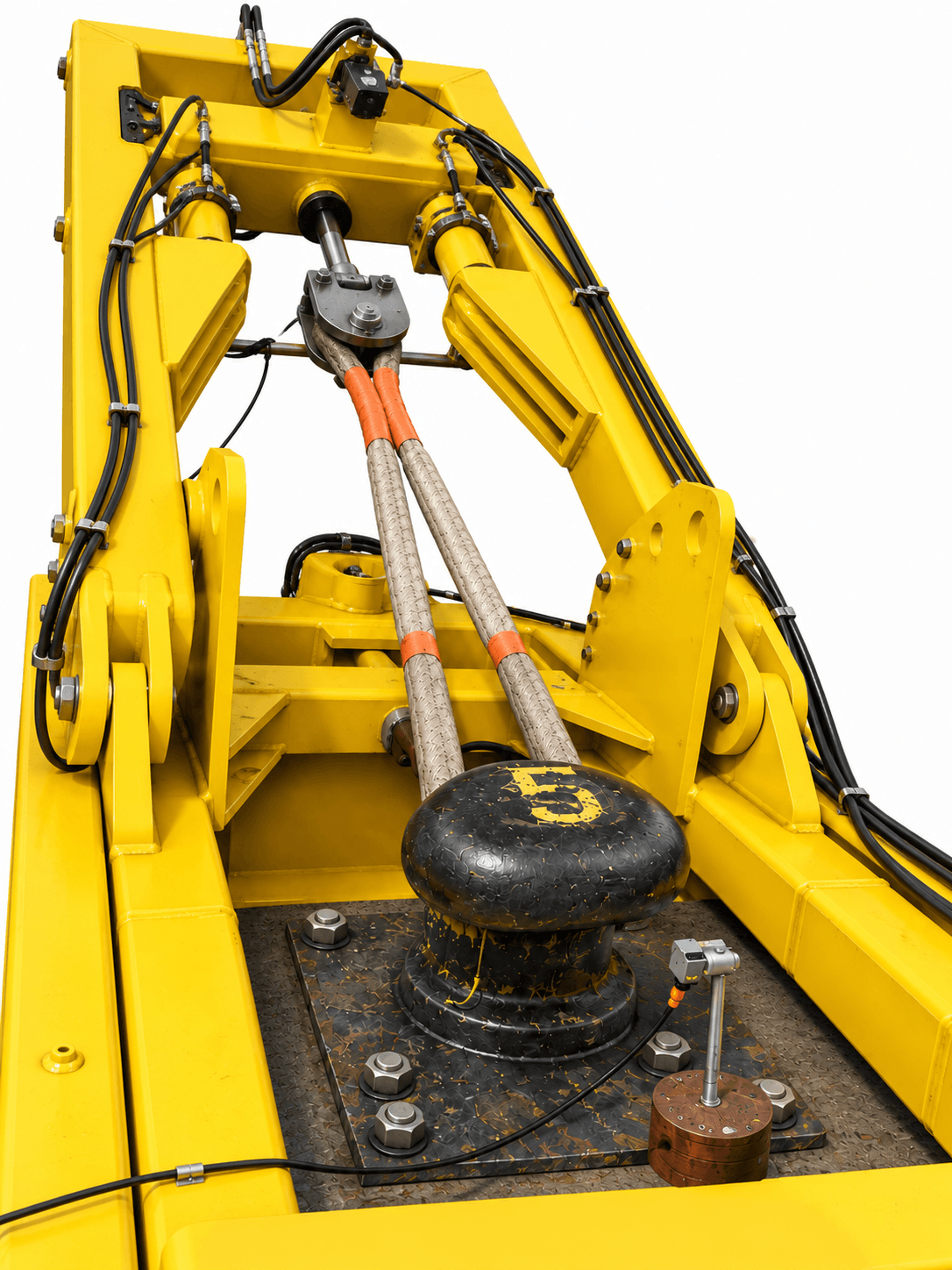
The patented Bollard Proof test bench is a portable device that can be delivered to the dock. Unlike other current methods of testing bollards, such as the pull test between adjacent bollards or hammer tests that record and analyze the resonance in the bollard , our system simulates the load of a ship's mooring line pulling on the bollard at different angles (vertically and horizontally).
You will then receive a dated test certificate per bollard, with the maximum safety capacity of the bollard (SWL) as well as the details of the angles tested.
What if the bollard is in poor condition?
The test is carried out remotely from a control van with an umbilical line between the traction bench and the van.
The motion and load measurement sensors of the integrated cameras record each test.
The hawser, connected to the bollard, is pulled by a jack from outside the quay.
The tested bollard is encapsulated in a transparent, ballistic-grade cage that retains broken pieces.
The broken parts are retained in order to carry out a metallurgical analysis and establish the cause of failure.
We can test new or existing bollards to customer requirements. The bollards will be pulled at vertical and horizontal angles combined with their nominal working capacity, or 10% beyond.